Comparison
Robotic vs Suction Pool Cleaners: Which Is Worth It?
Suction cleaners are cheap to buy but run on your pool pump; robots cost more but clean walls, filter their own debris and use little power. We compare cost, cleaning and upkeep.
This page contains affiliate links; we may earn from purchases made through them. Learn more

Beatbot
Beatbot Sora 10
7.9/10 research scoreFloor, walls and waterline for up to 5 hours, with its own filter.
Wybot
WYBOT C1
6.9/10 research scoreBudget robot with weekly scheduling for pools up to 1,615 sq ft.
The short answer
A robotic cleaner is worth it for most pool owners: it scrubs walls and the waterline, keeps debris out of your pool filter and doesn't need the main pump running. A suction cleaner still makes sense on a tight budget, especially with a variable-speed pump.
Both clean your pool floor automatically, but they work in completely different ways, and that changes what they clean, what they cost to run and what they do to your other equipment. Most guides on this topic come from robot makers, so we stick to how each design works.
How they work
- Suction cleaners connect to your skimmer or a dedicated suction line. Your pool pump pulls water through them, which moves the cleaner and carries debris into the pump basket and your pool filter.
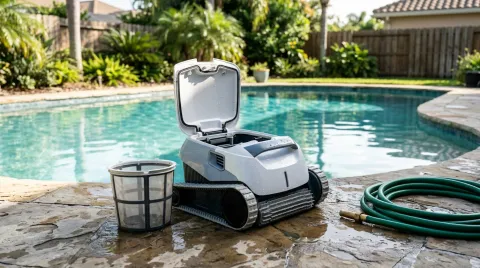
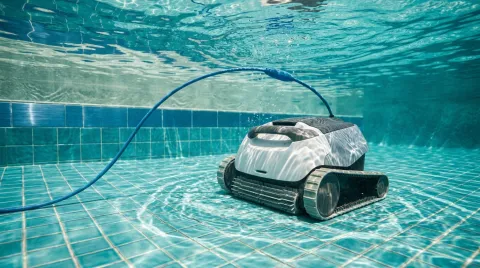
- Robotic cleaners are self-contained: their own motors drive them and pump water through their own filter. They don't connect to your pool's plumbing at all.
Compared
| Factor | Robotic | Suction |
|---|---|---|
| Cleans | Floor, and usually walls and waterline | Mostly floor, some walls |
| Where debris goes | The robot's own filter basket | Pump basket and pool filter |
| Needs the pool pump | No | Yes, for every cleaning |
| Buying cost | Higher | Lower |
| Running cost | Low-voltage motors | Extra pump hours |
| Upkeep | Empty the robot's filter | Backwash or clean the pool filter more often |
Running costs
A suction cleaner's real cost is the time your pump runs to power it. Robot makers estimate robots at a few cents per cleaning; one maker's estimate puts yearly energy at roughly $20 to $40 for a robot and $30 to $70 for a suction cleaner at 100 cleanings, at their assumed electricity price. Treat those as rough: a variable-speed pump at low speed narrows the difference considerably.
When suction is enough
- You're on a tight budget and already run the pump daily.
- Your pool has light debris and you're happy to brush walls yourself.
- You have a variable-speed pump.
When a robot is worth it
- You want walls and the waterline scrubbed without brushing.
- You'd rather keep debris out of your pool filter.
- You want to clean without running the main pump.
Beatbot
Beatbot Sora 10
List price $699 (as of Oct 2026)
Best for: Medium to large in-ground or above-ground pools on a budget
Bottom line
For most owners, a robot cleans better and costs less to run. Robots that clean floor, walls and waterline now start around $400 to $500 on sale, close to a good suction cleaner. Compare picks in our under $500 list.
| Spec | Beatbot Beatbot Sora 10 | Wybot WYBOT C1 |
|---|---|---|
| Research score | 7.9/10 research score | 6.9/10 research score |
| List price | $699 | $569.99 |
| Cleaning coverage | ||
| Floor cleaning | Yes | Yes |
| Wall cleaning | Yes | Yes |
| Waterline cleaning | Yes | Yes |
| Surface skimming | No | No |
| Cleaning modes | 4 modes | 5 modes (best) |
| Max pool area | 3,229 sq ft (best) | 1,615 sq ft |
| Filtration | ||
| Filter type | Top-load filter basket | Top-load filter box |
| Finest filtration | 150 µm (best) | 180 µm |
| Filter capacity | 5 L | Not published |
| Battery and power | ||
| Battery capacity | 7,800 mAh | Not published |
| Runtime (floor only) | 300 min (best) | 150 min |
| Maximum runtime | 300 min | Not published |
| Charging time | 3.5 h | 3 h (best) |
| Wireless charging | No | Not published |
| Navigation and smart features | ||
| Navigation | S-path with SonicSense ultrasonic obstacle avoidance (11 sensors, 1 ultrasonic) | S-path (floor) and N-path (walls) |
| App control | Yes | Yes |
| Wi-Fi | Yes | Not published |
| Bluetooth | Yes | Not published |
| Scheduling | Not published | Yes |
| Ease of use | ||
| Surfaces for retrieval | Yes | Yes |
| Weight | 18.74 lb | 17.6 lb (best) |
| Dimensions | 17.01 × 15.20 × 10.51 in | Not published |
| Warranty and support | ||
| Warranty | 2 years | 2 years |
| Where to buy | Check price at Beatbot (opens in a new tab) | Check price at WYBOT (opens in a new tab) |
Frequently asked questions
Is a robotic pool cleaner better than a suction cleaner?
Does a suction cleaner use more electricity?
How much do suction cleaners cost?
Sources
Specs, prices and claims in this article come from these sources.
- Robotic vs suction pool cleaners · Aiper · accessed Oct 16, 2026
- Pool cleaner operating costs: robotic vs suction vs pressure · Dreame · accessed Oct 16, 2026
- Robotic vs suction vs pressure pool cleaners · iGarden · accessed Oct 16, 2026
Written by
Research and editing
The PoolRobots editorial team researches robotic pool cleaners from manufacturer documents, published measurements and owner reports.